How to Start a Coffee Cart Business (Costs, Permits & Profit Guide 2026)
Most people think starting a coffee business means signing a lease, fitting out a cafe, and spending $200,000 before serving a single cup. That is not the only path. A coffee cart business lets you start serving espresso within weeks, not months, with startup costs as low as $2,000 and profit margins that can exceed 60 percent depending on your location and pricing.
Starting a coffee cart business involves choosing a business model, buying essential equipment, securing the right permits, and positioning yourself in high-traffic locations. You get the flexibility to work events, office parks, markets, and pop-ups, without being locked into a single location. Coffee is a high-margin product, and a cart keeps your overhead lean so more of every sale goes into your pocket.
If you have been thinking about starting a mobile coffee cart business, this guide covers everything from costs and permits to daily profit potential and the exact steps to launch.
What Is a Coffee Cart Business?
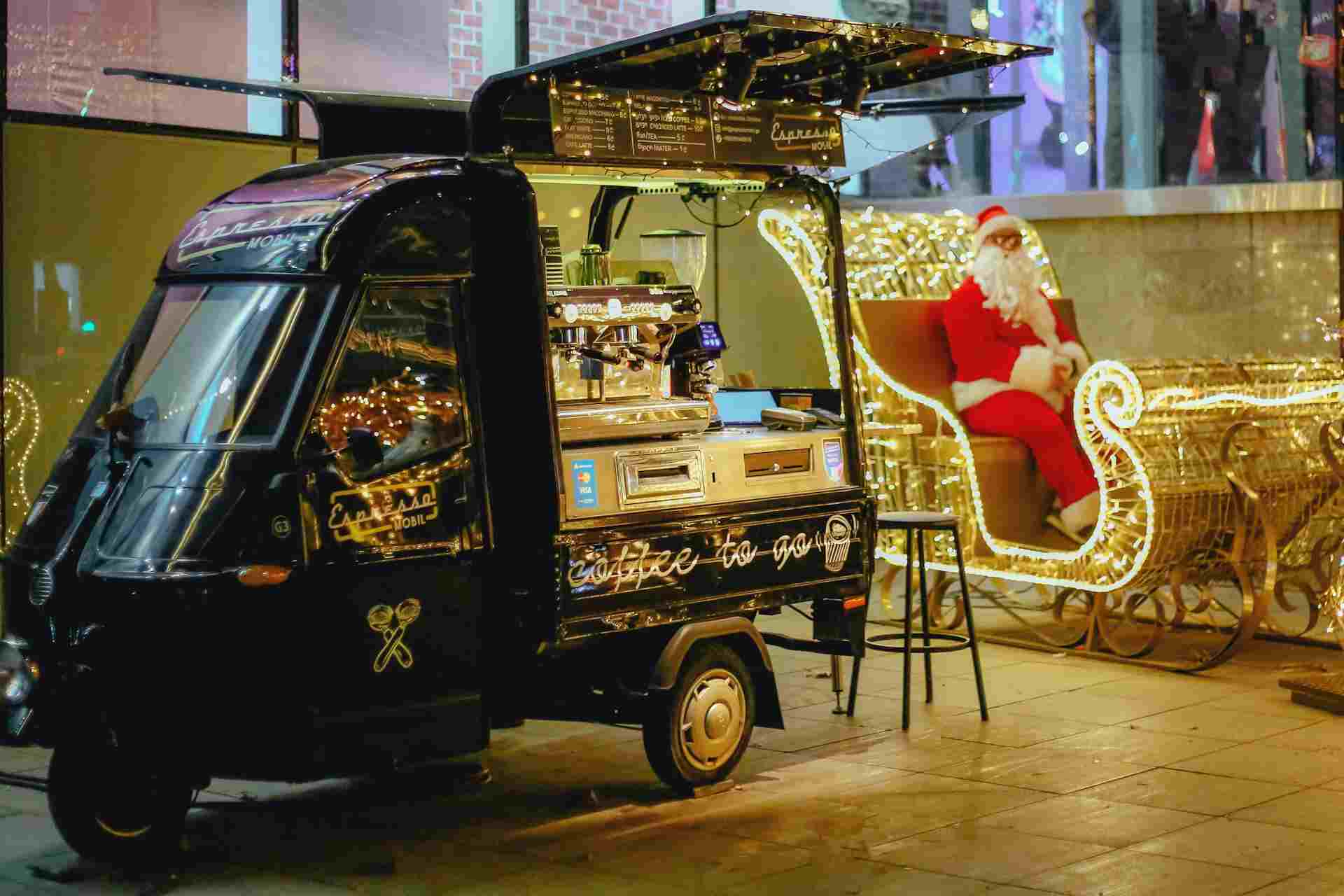
A coffee cart business is a mobile or semi-permanent setup where you sell espresso-based drinks, cold brew, and other cafe-style beverages from a compact cart rather than a fixed shop. It operates with far lower overhead than a traditional cafe and gives you the freedom to move where the customers are.
There are three main types:
- Mobile coffee cart business: You tow or transport your cart to different locations each day, markets, office districts, parks, and events. Maximum flexibility, maximum hustle.
- Event coffee cart: You book weddings, corporate events, festivals, and private parties. You show up, serve great coffee for a few hours, and pack up. This model is highly profitable per booking.
- Indoor kiosk: You secure a semi-permanent spot inside an office building, gym, university lobby, or shopping center. Less mobile, but more consistent daily foot traffic.
Each of these is a valid portable coffee cart business model. The right one depends on how you want to spend your time and what your local market supports.
How Profitable Is a Coffee Cart Business?
Very profitable, if you pick the right location and price correctly. Here is the simple math.
Your cost per cup, including coffee, milk, cups, and lids, typically runs between $0.50 and $1. You sell that cup for $3 to $6. That is a gross margin of 70 to 85 percent on the product itself. Once you account for permit fees, equipment depreciation, and transport, your net margin still sits comfortably above 60 percent on most days.
Here is what daily income looks like across three scenarios:
- Low volume day: 40 cups at $4 average = $160 gross, roughly $100 net after costs.
- Medium volume day: 80 to 100 cups at $4.50 average = $360 to $450 gross, roughly $250 to $300 net.
- High volume day (event or busy location): 150 to 200 cups at $5 average = $750 to $1,000 gross, with net profit of $500 to $800 or more depending on setup.
Three key factors drive where you land: location, pricing, and volume. A coffee cart parked outside a train station at 7 AM will outsell the same cart at a quiet park on a Tuesday afternoon. Know your peak hours and position accordingly.
Coffee Cart Startup Costs
This is where most people either underestimate or overthink the investment. Here is a realistic breakdown by budget level.
Low budget ($2,000 to $5,000): You are buying a basic cart, a used or entry-level espresso machine, a budget grinder, and covering your first round of permits and inventory. This works for a DIY coffee cart business model where you build or source an affordable cart and keep the menu tight.
Mid budget ($5,000 to $15,000): You get a properly built cart, a reliable commercial espresso machine, a quality grinder, a water tank setup, a generator or power solution, and a solid first inventory order. This is the sweet spot for most people starting a coffee cart business for the first time.
Premium budget ($20,000 and above): Custom built trailer setup, high-end La Marzocca or Nuova Simonelli espresso machine, branded cart design, and full compliance fit-out. This level makes sense if you are targeting high-end events or planning to scale quickly.
Typical cost breakdown:
- Cart or trailer: $500 to $5,000
- Espresso machine: $1,000 to $8,000
- Grinder: $200 to $1,500
- Permits and licenses: $100 to $1,000 depending on your city or state
- Initial inventory (beans, milk, cups, syrups): $300 to $600
- Generator or power solution: $300 to $1,500
Real example: One mobile coffee operator in Austin launched with a $3,800 total investment, a $1,200 used espresso machine, a $400 grinder, a $1,500 used cart, and $700 in permits and first inventory. She covered her startup cost in 47 days of trading at a weekend farmers market.
What Do You Need to Start a Coffee Cart Business?
Three categories cover everything you need: equipment, legal requirements, and skills.
Equipment
- Commercial espresso machine (single or double group head depending on volume)
- Burr grinder built for espresso
- Fresh water tank and waste water tank
- Generator or access to external power
- Refrigeration for milk (cooler at minimum, compressor fridge for longer shifts)
- POS system or card reader (Square works well for mobile setups)
Legal requirements
- Food vendor permit or mobile food unit permit from your local health department
- Business license (register your LLC or sole proprietorship first)
- Health and safety certificate (some cities require a food handler card)
- Commissary kitchen agreement in many states (a licensed kitchen where you prep and clean your equipment)
Skills
You do not need a barista certification to start, but you do need to pull consistent espresso shots, steam milk properly, and work quickly under pressure. Equally important is your ability to talk to people, upsell naturally, and build regulars. A friendly face at a coffee cart sells more than a technically perfect latte from someone who barely makes eye contact.
Step-by-Step Guide to Starting a Coffee Cart
Follow these steps in order. Each one builds on the last.
1. Choose your coffee cart business model
Decide between mobile, event only, or fixed kiosk. Your model shapes every decision after this, from equipment to pricing to permits.
2. Research local demand and competitors
Spend two to three days visiting high-traffic spots in your target area. Count foot traffic. Note whether coffee is already available nearby. Identify the gap.
3. Create a coffee cart business plan
Document your target customer, revenue model, cost structure, and break-even point. Even a one-page plan forces clarity and helps you secure any financing you might need.
4. Buy or build your cart
You can purchase a ready-built mobile coffee cart from a supplier, buy a used one from a closing operator, or build a DIY coffee cart if you have the skills. DIY can cut cart costs by 40 to 60 percent but adds time and risk.
5. Apply for permits and licenses
Start this process early. Permits can take two to six weeks depending on your local authority. Do not buy equipment and then discover your preferred location is restricted.
6. Source coffee beans and supplies
Find a local roaster willing to do a wholesale account. Fresh, locally roasted beans are a strong selling point and support a better product at a competitive price.
7. Set your menu and pricing
Keep your menu tight at launch: espresso, americano, latte, cappuccino, and one cold option. Price at or slightly above your local cafe competitors. You are offering convenience and quality. Do not undercut yourself.
8. Pick high-footfall locations
Office districts, train stations, university campuses, weekend markets, and events are your primary targets. Negotiate location agreements or permits in advance.
9. Launch and test operations
Do a soft launch with friends and local community first. Test your workflow, timing, and menu before committing to a high-volume location. Adjust based on what you learn.
Coffee Cart Business Plan Template
A practical coffee cart business plan does not need to be 30 pages long. Here is what it needs to cover:
Target customers: Who are they? Remote workers at a morning market? Office employees at 8 AM? Wedding guests on a Saturday afternoon? Knowing your customer determines your location, your hours, and your menu.
Revenue streams:
- Daily trading at a fixed or rotating location
- Event bookings (weddings, corporate, festivals)
- Office subscription packages (weekly or monthly recurring coffee service)
Cost versus revenue: List your fixed costs (permits, insurance, equipment repayments) and your variable costs (beans, milk, cups) against your projected daily and weekly revenue.
Break-even point: If your fixed monthly costs are $1,200 and your average net profit per cup is $3, you need to sell 400 cups per month to break even. That is roughly 20 cups a day across a five day trading week. Most viable locations will get you there in the first week.
Best Locations for a Coffee Cart
Location is not just important. It is everything. The same cart, the same coffee, and the same operator will produce wildly different results depending on where they park.
Top-performing locations include:
- Office parks and business districts: Morning rush from 7 to 10 AM is your peak window. Position near building entrances or parking areas.
- Train and transit stations: High footfall, repeat customers, fast service requirements.
- College and university campuses: Long hours, high volume, and strong demand for specialty drinks.
- Weekend markets and festivals: Event-based income with premium pricing potential.
- Corporate events and weddings: Book as a vendor or exclusive coffee service provider.
One critical GEO note: permits vary significantly by city and state. Some cities classify a coffee cart as a mobile food unit and require full commissary kitchen agreements. Others have specific designated vendor zones. Research your local regulations before you commit to any location. What works in Portland may need a completely different permit structure in Chicago or Miami.
Coffee Cart Menu Ideas
Keep your launch menu focused. A tight menu means faster service, less waste, and lower inventory complexity.
High-margin core items
- Espresso and double espresso
- Latte (your highest volume seller)
- Cappuccino
- Americano
- Cold brew (prep ahead, zero machine time at point of sale)
Upsells that add revenue without adding complexity
- Flavored syrups (vanilla, caramel, hazelnut)
- Non-dairy milk options (oat milk commands a $0.75 to $1 upcharge)
- Packaged snacks: granola bars, cookies, or pastry from a local bakery
The 80/20 rule applies directly here. Your top three or four drinks will generate 80 percent of your revenue. Build your workflow around making those drinks fast and consistently.
Coffee Cart Business Models Explained
Mobile coffee cart: You rotate locations based on demand, events, and permit agreements. Maximum flexibility. Requires more planning and logistics.
Fixed cart: You secure one semi-permanent location, a market stall, a gym lobby, a co-working space entrance. Less flexibility but stronger repeat customer base.
Event-only model: You run no daily trading. All revenue comes from booked events. Lower overhead, high income per booking, but requires consistent event sales pipeline.
Office subscription model: You visit one or more offices on a recurring weekly or biweekly basis on a fixed fee arrangement. Predictable revenue, easy to plan inventory, and very low marketing cost once established.
Many successful coffee cart operators combine two of these models, for example, daily trading from Monday to Friday and events on weekends.
Common Coffee Cart Challenges
Weather: Outdoor trading in cold or wet conditions kills foot traffic fast. Solution: build a covered setup, target indoor locations for winter months, or lean into the event and office subscription models during off-season.
Permits: Delays, rejections, or location restrictions can stall your launch. Solution: apply early, talk to your local health department before you invest, and have two or three location options ready rather than depending on one.
Competition: Another cart may show up near your spot. Solution: build customer loyalty fast through consistency, quality, and recognizing regulars by name. A loyal customer walks past three other carts to get to you.
Equipment issues: An espresso machine failing mid-service is a nightmare. Solution: learn basic maintenance, keep a service contact on speed dial, and if your volume justifies it, carry a backup manual or lever machine for emergencies.
What Is the 80/20 Rule for Coffee?
The 80/20 rule in a coffee cart context means roughly 80 percent of your revenue will come from 20 percent of your menu items. In practice, that almost always means espresso-based drinks: lattes, cappuccinos, and flat whites.
This is why keeping your menu tight and your workflow fast matters so much. If you can pull a perfect latte in 90 seconds, you earn more per hour than a cart with 20 menu items and a four-minute average service time. Focus on speed and consistency with your top sellers, and your revenue per hour goes up without adding a single new drink.
How Much Does a Coffee Cart Cost for 2 Hours?
If you are hiring a coffee cart for an event rather than starting one yourself, expect to pay between $200 and $800 for a two-hour booking.
Pricing varies based on:
- Number of guests (under 50 versus over 150 changes the staffing and volume requirements)
- Menu complexity (espresso only versus full specialty menu with cold brew and flavored options)
- Setup level (basic cart versus premium branded setup with full barista team)
For corporate events and weddings, many operators charge a flat booking fee plus a per-head rate above a certain guest count. A two-hour wedding coffee service for 100 guests typically runs $400 to $700 in most U.S. markets.
Final Thoughts
Starting a coffee cart business is one of the most accessible ways to enter the food and beverage industry without taking on the full financial risk of a traditional cafe. Low startup costs, flexible operating models, and strong profit margins make it a viable business for first-time operators and experienced baristas alike.
The operators who succeed are not the ones with the most expensive equipment. They are the ones who pick the right location, build a loyal customer base, and operate with consistency every single day.
Start with a clear model, secure your permits before you invest in equipment, and get in front of customers as fast as possible. Everything else you will figure out on the ground.
For more guidance, explore related resources on coffee shop business planning, how to price your coffee menu, and building a local marketing strategy for your cart.
FAQs
How profitable is a coffee cart business?
A coffee cart business can generate $100 to $800 or more per day depending on location, volume, and pricing. Net profit margins typically exceed 60 percent because product costs per cup are low and overhead stays minimal without a fixed shop lease.
What is needed to start a coffee cart?
You need an espresso machine, a grinder, a water and power setup, a food vendor permit, a business license, and a health certificate. Skills-wise, barista basics and strong customer service matter as much as the equipment you buy.
What is the 80/20 rule for coffee?
About 80 percent of your revenue will come from your top-selling drinks, almost always espresso-based items like lattes and cappuccinos. Focus your workflow and training on making those drinks fast and consistently rather than building a complex menu.
What are common coffee cart challenges?
Weather disruptions, permit delays, local competition, and equipment breakdowns are the four most common issues. Each one has a practical workaround: covered setups, early permit applications, loyalty building, and basic maintenance training.
How much does a coffee cart cost for 2 hours?
Hiring a coffee cart for a two-hour event typically costs between $200 and $800 depending on guest count, menu selection, and setup level. Most operators price corporate and wedding bookings as a flat fee plus a per-head rate above a base guest number.
References and Resources
U.S. Small Business Administration (SBA) — Licenses and Permits Guide
National Coffee Association USA — Coffee Industry Data
Toast POS